Monday, July 25, 2011

The Path to Brains

In late 2006 (yes, this story starts five years ago) Microsoft released the first version of XNA, a development platform for writing games on the PC and Xbox.  It put all the nitty-gritty details that generally plague game development behind a modern type-safe programming language (C#).  It let developers focus on the more interesting aspects of game design.  As someone who has dabbled in game development in the past, this simplified platform sounded like a great way for me to get back into it.

I wanted a project that fit me and my personal strengths, so I decided on a 2D game where I could provide the art with old fashioned pen and paper.  This would accomplish two things: it would give me an excuse to reconnect with the visual arts, and it would produce a different visual style from most of the other stuff out there.  I imagined a sketchy hand-drawn style, like doodles in a notebook come to life.  Of course I wasn't the only one to have this idea, and in fact many games have come out in the years since with this style.  Many have fallen short because they fail to embrace the look completely, while others have pulled it off brilliantly (like the enjoyable Parachute Panic).  But from my perspective at the time, it wasn't a look that had been done.

In grade school I used to draw stick figures doing terrible awful violent things to each other.  It's one of those things little boys do to vent their natural homicidal tendencies (medical term: testosterone), similar to throwing rocks and blowing stuff up with firecrackers.  The thing that somehow makes this sort of thing vaguely less disturbing is that... well, they're stick figures.  It's cartoon violence at its most cartoon state.  I'm not going to get into a discussion about violence in media right now - I'm just presenting this a data point.

The trick with violence is that you need a morally justifiable sponge to soak it up so that the audience doesn't feel morally queasy.  Very few realistic targets hold up to that job, so we've invented all sorts of other options to fill out the ranks.  In particular, zombies are somewhat of a violence loophole.  They're almost indistinguishable from their living counterparts, yet for some reason we heartily approve of them meeting their (second) end via a chainsaw.  I think it's the outnumbered survivalist viewpoint that allows us to use a certain "vigor" in our zombie eradication methods.  It's not as simple as the "its your or me!" factor; it's the "its you or… oh god where did you all come from… must… escape...  aaaaarrrrrgh!" factor.

Where am I going with this?  Well, when it comes to video games, violence is a common crutch because our brain easily understands "death == losing".  And when it comes to violence, zombies are a generally agreeable adversary.  So when I decided to make a game, I decided to make a zombie game.  It's also possible that its just because I had recently rolled off of playing Dead Rising.  In going back to unravel the timeline I remembered that I'd actually already posted about the topic of zombie gaming here in 2007.  That post was actually a product of me thinking about what sort of game I wanted to make.  And that exercise led me down the path of discovering modern designer board games.  Which it turns out has turned into quite a hobby for me.

Well, despite the crazy cascade of events that this project kicked off, you'll notice I never released a game during all those years.  In 2008 a version of XNA was released that supported the Zune device.  At the time I worked on the Zune team at Microsoft, and developing for our little music player seemed like a fun goal.  So I took what I had built before and adapted it for the small screen.  I got it pretty far along, but in the end I lost steam because there frankly wasn't any market to release it to.  It was fun as a toy for myself, but it would never be more than that.

A couple years later XNA added its fourth platform: Windows Phone.  In the years that had passed, the iPhone had become a great market for indie game developers.  And I had software that could run on a phone, more or less ready to go.  So I got it up and running as soon as the developer tools were available.  But I never quite pushed it out the door and on to the marketplace.  Why?  Well, full disclosure, I worked on Windows Phone.  And I was too busy busting my butt on that product to have any free cycles to work on some programming side project.  I code for a living; it's rare for me to get the capacity for additional coding.

It took me another year to find the time and finish the project.  I decided to rework the art style, switch to a female protagonist, streamline the touch controls, build the features you expect of a phone game (e.g. save/resume), and of course polish it all as much as possible.  The end product is something that I'm proud of, but it isn't anywhere near as grand as the ideas that initially got me started.  It's a simple little action game.  That's it.  I think it's a good little action game, and I haven't played anything quite like it on Windows Phone, but it is a little bit of style over substance.  I'm okay with that.  This is my first ever release as an independent developer.  Now that the hard part is out of the way I can hopefully tinker more and work one some of those deeper ideas.


MustEatBrains is now available for download for Windows Phone here.

Tuesday, July 19, 2011

Back to Creation

Mostly on this blog I've posted about consumptive experiences.  Video games, board games, movies, music… in short, "media."  I experience media, in whatever form, and then sometimes I post thoughts about it here.  However I do feel like part of life is adding to the conversation, not just being a consumer.  Writing is one form of contributing (given the sort of writing I'm doing is derivative, not purely creative, but it's something).  However there is a key way that I've been working on contributing over the past couple years that I haven't mentioned here at all.

I've always had some aptitude for committing visuals to the page.  But art is one of those things where in our youth we're all equals and over time the skill level spreads out dramatically.  Through school I drifted in that awkward middle space: expressive enough to be considered artistic by normal people, but not nearly good enough to actually be an artist.  That's it there, isn't it?  Artistic vs. artist.  Or maybe more appropriately: "artist-ish."

As I continued taking classes in school it both became clear that I had some knack for this, but also that I lacked the skill and inspiration to really do anything meaningful with it.  Skill is something you can work on, and the inability to understand the incremental improvements is something that most people see as a brick wall when it comes to art.  Inspiration is something else entirely, in that it's difficult to manufacture.  The short of this story is that I let art slip out of my life, much like I did for music.  And while I know that for a variety of reasons that I'm not cut out to be an artist, there is a great need in my life for creation and art is a fantastic way to satisfy that need.

So it is that about two years ago I did something about it.  With the help of a dear friend, I left my comfort zone of pencil and paper and picked up a paint brush.


I started with watercolors.  And I think this piece here is the first I was happy with.  Yes, it's Metroid fan art.  Remember what I said about inspiration being a problem?  Sometimes you need to borrow a spark.


Before too long I worked my way into acrylics.  I started on canvas paper, not wasting real canvas on my initial fumbling.  This piece here is one that I like.  Bats are adorable.


The next step in confidence was canvas board.  Still not real canvas, but a larger vote of confidence.  This one of a kraken attack is one that I like.


Painting is meditative; working with physical colors is a wonderful (if unforgiving) experience.  I also sit in front of a computer all day, so I wanted to keep my distance from digital painting.  But it has a place, especially as a means of experimentation.  This piece here is one of the digital paintings I've done.


I'm now at the point now where I feel like I can use real canvas and not be wasting it.  This guy here is a return to the subject matter of that original watercolor.  I like him for many reasons, but not least of them is how much growth the piece shows.


Waste a canvas?  Ha!  How about eight?  This project is a series of paintings, which I've failed to adequately photograph together.  I'm very happy with them.  The next step is to figure out how I'm going to hang them, because I'm now willing to hang my own art in my own home.  Progress.

With all this exploration in color and texture I felt like I earned the right to return to the cold hard world of pen and pencil.  I just completed a rather ambitious project in that space which you'll be hearing about here very soon.

That's been my journey so far.  I will try to comment on it more here as I feel is appropriate, but if you really want to track what I'm up to the best way is via my DeviantArt page.  You can get a feed on that, and I've also added that as a gallery widget to this blog on the right.

Tuesday, May 17, 2011

Postcards from Middle-Earth - Part 2

Continuing our pictorial journey through Middle-Earth…

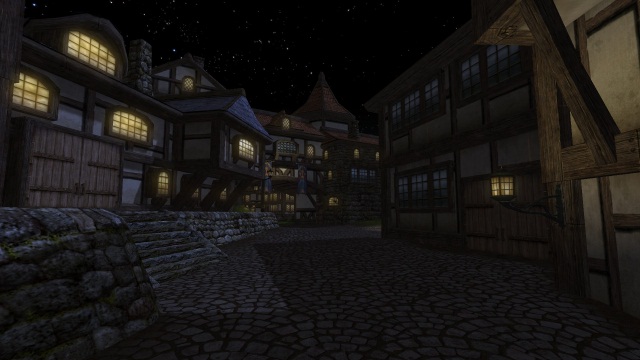
We left off our journey arriving at the town of Bree.  Here you can see it at nighttime.

More ruins from ages past.

Ah, the swamp with the neeker-breekers.  Which of course in the game are not just an audio component, but big bugs that you have to squash.

More swamp.  I took a ton of shots of the swamp because I found it so oddly beautiful.  The low sun hitting the haze, with all the ruins poking out of the muck… not exactly inviting, but not exactly an eyesore either.

We've worked our way out of the swamp and into the Lone Lands.  Here you can see Weathertop, also known as the ruined tower of Amon Sûl.  In the game you can play out a nighttime defense against a ringwraith raid.

South of Weathertop there's this rundown inn along the main road (which of course Strider avoided as much as possible).

Some ruins in the Lone Lands.  In the background is the fort of Ost Guruth, which isn't covered in the fiction at all but does serve as an important quest hub for players in the game.

We've worked our way out of the rather desolate Lone Lands and into the area known as the Trollshaws.  On account of, well, the trolls.  But when it's not pouring rain and you're not getting bagged by a wandering troll it can be quite lovely.

Speaking of trolls, here are a few famous ones.  Bert, Tom, and William can be found as the stone statues that Bilbo and company left them in.

Here's a river going through part of the Trollshaws.  Not the river, mind you (by which I mean the Bruinen, the river that Elrond used against the Nazgûl).

South of the main road and the great river's ford it all empties into a little lake.

We've crossed the river, climbed up and down, and have now descended into the valley of the elves: Rivendell.

Some of the nice architecture of Rivendell.

Here we've stepped inside the Last Homely House: Elrond's home.  Apparently he doesn't live humbly.

At least Elrond knows how to entertain.  In his decadent dining hall you can find old Bilbo, happy to play the riddle game with anyone who's willing to chat with him.  Nothing like a creepy old hobbit walking around asking you what's in his pocket.

Thursday, April 28, 2011

Music Made Me

In the  book High Fidelity (and the movie too, for that matter), the main character is obsessed with making "Top 5" lists and categorizing his music collection.  There's a moment where he decides to organize his records autobiographically - the order in which he experienced them.  I've always been intrigued by that idea: trying to express one's journey in life through the music that accompanied it.  So I'm going to do just that, except instead of sorting stacks of records I'll be producing a playlist.

Unlike the character in the book I have no intention of organizing every single piece of music I own in such a matter.  Really I just want to capture the inflection points.  The problem is that as soon as you introduce choice into this exercise it becomes an entirely different activity.  In defining the timeline of my life, what music was most important?

Do I choose songs that represent the evolution of my taste in music?  Or do I choose songs that are steeped in personal memory?  Sometimes hearing a song can take me to a time, or to a specific feeling.  Some songs are tied so tightly to poignant memories that hearing them transports me to an exact moment.  Clearly a musical timeline of my life has to include these songs.  They may not represent me musically, but they do represent my human experience.

As I've tried to put this list together it's become clear that I can't just do one or the other.  A progression through my music tastes alone is soulless;  a trip through the  highlights of emotional moments lacks context.  There needs to be an intentional blend in order to achieve a sensible storyline.  It's a tricky task, and one I've been working on for months now.

I've finished reconstructing my timeline, and now it's down to the logistics of writing, linking, and presenting this to the vast anonymity of the internet.  Let this post serve as an introduction to the project.  The next time you hear about it we'll jump right into the early years of my exposure to music.  Everything from Bob Marley to Michael Jackson to even New Kids on the Block.  You heard me, I'm baring it all.

Next

Monday, April 25, 2011

Postcards from Middle-Earth - Part 1

I'm generally not a fan of landscape photography.  Maybe it's because the subject matter is infinitely patient.  In general the photo will have everything in focus, and whatever is being captured has been there longer than you or I.  There's no immediacy to it.  Sure, mountains and trees and waterfalls are pretty, but I just don't know what a landscape photo is telling me other than "doesn't wherever you are now suck in comparison?"

While writing my series on Lord of the Rings Online I decided I wanted screenshots to go with it, and that for some reason it was important that they be personally taken screenshots instead of stock images from whatever the internet had to offer.  As I went about I decided I really enjoyed the hunt.  No longer was I just some hero in Middle Earth; now I was some hero with a camera.

Once I started I just couldn't stop, and I quickly gathered far more photos than I needed for my article.  So I've decided to post them here as a visual journey through Turbine's rendering of Middle Earth.  I feel like I was a little harsh on them, because truth be told there are many beautiful scenic areas in the game.  Anyway, here you'll find no rants about game mechanics, just pretty pictures and some light captions.  Enjoy.

It seemed natural for these photos to follow the hobbit journey from Hobbiton to Rivendell.  Here we have Bag End in all its cozy glory.  And excellent place to host a dozen dwarves.

A cute little hobbit hole cut out of the hillside.  I'm thinking maybe this whole rectangular door things is overrated.

Frodo was found of hikes into the woods around the Shire.  I imagine this forest path might have been one of his favorites.

Hobbits are none to comfortable around the water, but they have on big beautiful river running through the Shire.  In classic hobbit fashion this river is named "The Water".

They've gotta get over that river somewhere, and here's one of the crossings at nighttime with a Bounder keeping watch.  He probably doesn't see much action, and more than likely is drunk on the job.

It's daytime in this shot, but this is the Buckleberry Ferry where the hobbits escaped the black riders into Buckland.

I know they were trying to shake those scary black riders, but I don't think going through the Old Forest was the brightest idea.  It is not a happy place.

Here we have Old Man Willow, luring all passersby into a blissful slumber.

We've emerge from the Old Forest into the Barrow Downs.  Cairns and tombs, oh my!  You can't take two steps without stumbling over reanimated bag of bones.  This is where players will likely experience their first dungeon instance.

North of the forest are beautiful fields that would have provided a much more enjoyable path.  But I guess the big open is just begging for a Ringwraith to swoop through and gobble you up.

All throughout the land of Middle Earth are ruins of ages past, such as this one.

And here we see the town of Bree, looking perfectly pleasant in the day light.  For low level characters this is their main hub for banking and auctions.  I guess it's a more friendly place if you're not trucking around the One Ring of Power.

Thursday, April 21, 2011

The Guitar Story

There are many reasons that people who met me over a decade ago would see me differently than those who've met me recently, but there's one reason in particular that secretly bothers me.  Most people I know now would be surprised to hear that I used to play the guitar.  A lot.  The people I met before would be equally surprised to hear that I no longer do.

Everyone in high school seeks out their thing that sets them apart, and for me that became playing the guitar.  Well, that and I basically always wore the same poncho.  I was happy to later find out that the key feature I enjoyed (the marsupial pouch in front) could also be found much more fashionably in hoodies.  But this isn't a story about my deep abiding love of a good zip-up hoody.  This is the story of my rise and fall as a guitarist, my great shame, and how I plan to bring back something I once loved.

My parents purchased an old nylon string acoustic guitar at an auction sometime when I was very young.  I'm pretty sure the intention was that one of them would learn to play it, but I first found it in a closet sometime around the 6th grade.  This timing coincided with the beginning of what I'll overstate as my musical awakening.  I was beginning to really listen to music, and the idea of playing along and maybe creating my own music appealed to me.  So I picked up that guitar, turned on the radio, and tried to mimic the sounds I was hearing.

Keep in mind that this guitar was horrifically out of tune.  I had no teacher and no internet.  I hadn't the slightest clue what the relationships between the strings were supposed to be, so I just randomly tried different frets until it sounded like what was coming out of the radio.  Eventually I got a hold of some old guitar books and was able to correctly tune the strings relative to each other, but I think there was still a good stretch there where I tuned off of the radio.  (These kids today with their automatic electronic tuners, grumble grumble)

I remember playing for a talent show in middle school with a kid from my neighborhood, Mackenzie Pinch.  We did a little self-written acoustic duet.  The weird thing is I can't for the life of me remember what sort of audience we had, so I don't know if it a real talent show or just an audition.  I don't think they turn down anyone in middle school talent shows, so it must have been the real deal.  All I remember is being critiqued on my lack of showmanship.

I played with a couple of different friends over the years.  And of course every time we had to form a band name and concept.  I remember Kindred and Sterc in particular.  At one point I had a brief arrangement at a local church.  Mind you, at the time I was a stewing pot of venomous anti-Christian pseudo-intellectualism.  I think they hoped that by just being around the whole process it would somehow convert me.  It didn't work - I just enjoyed the opportunity to play with a band.  The songs weren't exactly rockin', but it scratched an itch.

So I played around, had a good time, and slowly got better.  But I don't think it really became part of my identity until after my Freshman year of high school.  It was then that I started bringing my guitar to school to play during the lunch break.  That thing went with me everywhere, and my playing really picked up a notch.  I had started my journey in the grunge era, and then went back in time through classic rock.  But the thoughtful acoustic licks of the Dave Matthews Band gave me some excellent material to work with in my senior year.

But there's a time for everything, and that time is college.  That's when my playing was at its peak.  Some random evening in my dorm I wandered onto the wrong floor which turned out to be the right floor.  I met Dan and Billy and we started playing music.  It became a regular thing, us playing in the common area in the evenings.  Half the students on the floor loved it and half hated it - presumably because they were trying to study or some nonsense.  But me for it was the best of times.  It was casual but fun.

One of us blossomed.  Dan stuck with it and has really grown into a lovely singer songwriter over the last decade.  You can check him out online here, or in person this Saturday the 23rd at the Crocodile.

The other component of playing music in college was sunny days on the quad or red square.  One of these days some dude came by and started playing with me.  His style was interesting, his material original, and we hit it off musically.  We agreed to meet again and it quickly became a regular thing.  It actually got kind of serious.  We started recording songs, performed in the university talent show (for real this time - I definitely remember this one), and most of my guitar activity started to revolve around this duo.  It seemed great at the time, but it was actually the beginning of everything unraveling.

The songs were his, and he also provided the vocals, so I settled into an accompaniment role.  It was nice to focus on that and grow my melodic skills.  But over time I became dependent.  It wasn't about what I brought to the table; it was about what I could add to what was already on the table.  All of my song ideas started to dry up from lack of attention.

I realized I didn't have a real personal connection with this guy and so I was only half interested in the partnership.  I eventually broke it off.  Well, I stopped returning phone calls.  Same difference?

I had left myself in a situation where when I picked up the guitar I didn't know what to play.  I had the skill to do something with it, but no spark of inspiration.  So I'd pick it up, fiddle around a bit, and then set it back down again feeling somewhat disappointed.  Eventually I started accelerated the process by not picking it up at all.  I got a job, moved, and it became all to easy to forget it all. 

It's hard to explain the emotion.  Sitting there feeling like you have this untapped potential.  You have a voice, but you have nothing to say.  I felt creatively barren, thoroughly uninspired and uninteresting.  And then I was ashamed for leaving it behind.  It had been such a huge part of me but then it was gone.  It's like an old relationship where there are all these awkward maneuverings to avoid having to think about what it used to be and how it can no longer be that.  You find yourself avoiding contact altogether just to prevent any opportunity to stir up old emotions.

Time has given me the perspective to understand what went wrong, but it's been harder to find a path to fix it.  Essentially, I became overly focused on creation.  If I couldn't bring something original to the table then I was a failure.  By concentrating on the value of creation, I had lost the simple joy of just playing.  Before it had never mattered if I was playing someone else's song.  But as soon as it mattered more if it was my song, my sense of contentment became susceptible to the ebb and flow of creative juices.  God forbid there be an extended period of ebb.

So the fix that had to be made was to restore that joy of playing.  It sounds easier that it is.  If every time you pick up an instrument you feel like a failure then it's hard to muster up the energy to idly strum a few tunes.  And the longer you go without playing, the fewer songs you can remember to play.  So even though I've known what the problem is for years, it's been hard to overcome the wounds and move forward.

Thankfully a potential solution has fallen from the heavens: Pro Guitar for Rock Band 3.  Basically you can now play a real guitar with Rock Band.  You choose the song, it'll tell you how to play it, and you can just focus on having a good time.  But it's real.  Real chords, real scales.  Real.  It's exactly the thing I've needed.  So I dropped the (not insignificant) chunk of cash on the setup to get me back on the wagon.

I've been at it for only a week now.  It's too early to say how this will play out.  But I'm optimistic.  It was good to feel the muscle memory kick into action and pick up right where I left it.  The callouses haven't fared as well, but a daily regiment will have those back in no time.  In the meantime I just have to pace myself a bit.  But I think it's working, and it's got me walking around with a bit more bounce in my step.


Sunday, April 3, 2011

RPS on Quest for Glory IV

I follow this UK PC gaming blog called Rock Paper Shotgun.  They're a bunch of well-spoken likeminded blokes, and I enjoy their words.  Anyway, they have this series called Gaming Made Me in which they deep dive into the more influential games of their past.  It's something that fits well with my selfish needs for this blog, so I've been thinking for awhile about tackling the same topic.

Well, then those rascally brits went ahead and covered one of my all time favorites: Quest for Glory IV.  Perhaps later I'll have more to say on the topic, but for now I'll just refer you to their words.  I will say I was both surprised and not surprised to learn that the voice actor for Commander Shepard and Katrina the vampire are one and the same.  Apparently Jennifer Hale is the common element in games that rock my world.

Wednesday, March 30, 2011

LotRO Revisited - Part 6 - Free to Play

At last we've come to the reason that I'm even talking about Lord of the Rings Online again in the first place: the fact that it's now to free to play.  But what does that even mean?

It means you don't need to pay a monthly subscription to play LotRO.  You don't even need a credit card.  You can play this game for dozens of hours on end and not spend a dime.  To do this you just set up an account on the website, click a button to download the game client, and start playing.  Easy.  Extremely high quality content for what you pay (nothing).

So, how is this possible?  The game developer clearly still needs to make money to pay for operating costs and ongoing development.  So they replace a fixed monthly subscription fee with a large set of optional "micro-transactions".  In other words you don't pay a fixed $15 a month, but instead you spend a couple bucks here and there on smaller purchases.  This will likely result in smaller per-account revenue, but by removing the steep up-front subscription cost it's possible to reach a broader audience and hopefully achieve similar overall revenue.  That's the basic business model, and it's an increasingly popular one.  But of course the devil is in the details.


The term "micro-transaction" conjures an image of being stopped every couple minutes to be solicited for money.  It sounds disruptive and cheap.  Certainly paying more up front sounds less obnoxious, right?  Well I'm happy to say that LotRO handles micro-transactions with class and restraint.

You can happily level a character up to at least level 30 before you really feel like you have to spend any money.  At that point you'll run out of free zones and maybe you'll put down $5 to unlock another zone for around 10 levels of quest content.  You don't have to, though.  The epic quest-line is always free, and there are always tasks, skirmishes, and level-scaling instances to keep you busy.

Smoothing everything over is the fact that you gain the real-money currency (Turbine Points) while playing the game.  Every deed you complete gives you some points.  So even if you absolutely refuse to spend real money on the game you'll still be able to pick up a couple things from the store.


So, what sorts of things can you buy?
  • Quest lines for levels 30-65
  • Additional skirmish instances to change up the scenery
  • Cosmetic outfits
  • Shared storage across all characters on your account
  • A wardrobe space for your characters to store and share cosmetic outfits
  • Shorter teleport home cooldowns and/or multiple home destinations
  • Short term acceleration for xp, crafting, or deeds
The larger priced items are content related (quests, skirmishes, etc.) or feature related (e.g. shared storage), and are usually a one-time purchase for the account.  They're less "micro" and more a replacement for that monthly payment.  The key difference being that unless you blaze through content too fast that it's going to be much cheaper.

The more controversial items are the true micro-transactions.  But you'll note that none of the them will outright make your character more powerful, they just make progression faster.  For example you can't buy levels, but you can spend a dollar to get a small percentage increase in your experience gain for 6 hours.  That means you'll level faster than someone who didn't pay any money, but it doesn’t give you better stats, or items, or anything like that.  You still have to play the game and overcome the same challenges.  It's fair.

The micro-transactions are all poised as purely optional efficiency boosts.  Sick of travel times?  Pay a quarter to make your next couple trips instantaneous.  Like crafting but don't have time for the grind?  Pay fifty cents to double the rate of craft skill gains for awhile.  This allows you to pick the parts of MMO grinding that annoy you and pay a little bit to have them go away.  The cynical way to look at this would be that they're making you pay to keep the game from being awful.  But the key thing to remember is that the free experience of today is the same thing people were previously paying a subscription for.  They didn't make it worse for free accounts.  You can pay for a more streamlined experience if you want to, but it's not necessary.  That's what helps the micro-transactions feel optional and not gouging.


I was really wary of the false promises of "free to play", but I've been extremely impressed with how elegantly LotRO has pulled it off.  I believe that you can play the game for free and have a perfectly good time.  I'm also happy to occasionally give them money to make my experience better.

Being presented with all these optional purchases forced me to confront what I really value about my MMO play experience.  It turns out that leveling faster isn't important to me, but looking cool is.  So my first purchases were an awesome looking set of cosmetic armor, some wardrobe space to save fun hats and such, and some more outfit slots so I can choose my look to match my mood.


I also bought some crafting acceleration to get my weaponsmithing skill up high enough to create my own weapons as I level.  I like feeling self sufficient.  Plus crafting is way more fun if you cut the grinding in half.  It's amazing how a numerical tweak can completely turn things around.

Beyond all that frivolous stuff I did pick up a couple quest packs after I cleared out the free zones.  I've enjoyed the skirmishes so I bought some more of those too.  I feel like now that I've spent some startup capital I can coast for quite awhile before my next purchase.  It's hardly been a free experience, but I feel like the money I've spent is well worth what I've received in return.

---


So, the real question: Is this the right game for you?

Do you like the depth and scale of MMOs, but have very limited time to play and can't justify a monthly fee?  Then the new free to play LotRO is perfect for you.  It doesn't matter if you progress through the game slowly because you'll pay for new content equally slowly.

Are you the sort of player who enjoys MMOs for the first twenty levels when things are fresh, then gets bored somewhere in the middle and quits?  Then LotRO would be a great fit for you because you'd probably quit right before you actually have to spend real money.

Do you get obsessed with your MMO and grind through content extremely quickly? Well then LotRO may still work for you because it still offers a compelling subscription option.  It's only $10, not $15, and you get a substantial grant of points every month (~$6 worth).  So it's kind of like Zune Pass where you get unlimited access but get to keep some stuff permanently if you ever cancel your subscription.

What I can't tell you is how well LotRO satisfies a player at the level cap.  I've got a character there, but I don't play him because I personally don't care for grinding the same content over and over again.  I do know that that there are raids, and there's a community of people running them.  But I don't know how well LotRO stacks up here.

From a value perspective LotRO is hard to beat.  High quality content, flexible pricing.  The real reasons to not play the game are if you don't like RPGs or you aren't particularly interested in the Lord of the Rings fiction.  If killing orcs in the English countryside bores you then this game is not for you.

If you do decide to try out the game, please set up your account using this link.  That referral will give me some kickback (and no, that's not what motivated me to write this series).  Be sure to create your character on the Gladden server, send me a note, and maybe we'll have a chance to adventure together.  See you in Middle-Earth!